

The thumbnail is the first thing your audience sees, and it decides whether your video gets the click.
thumbiq analyzes every variable of your thumbnail with a published academic model and proprietary metrics — measurable criteria, not hunches.
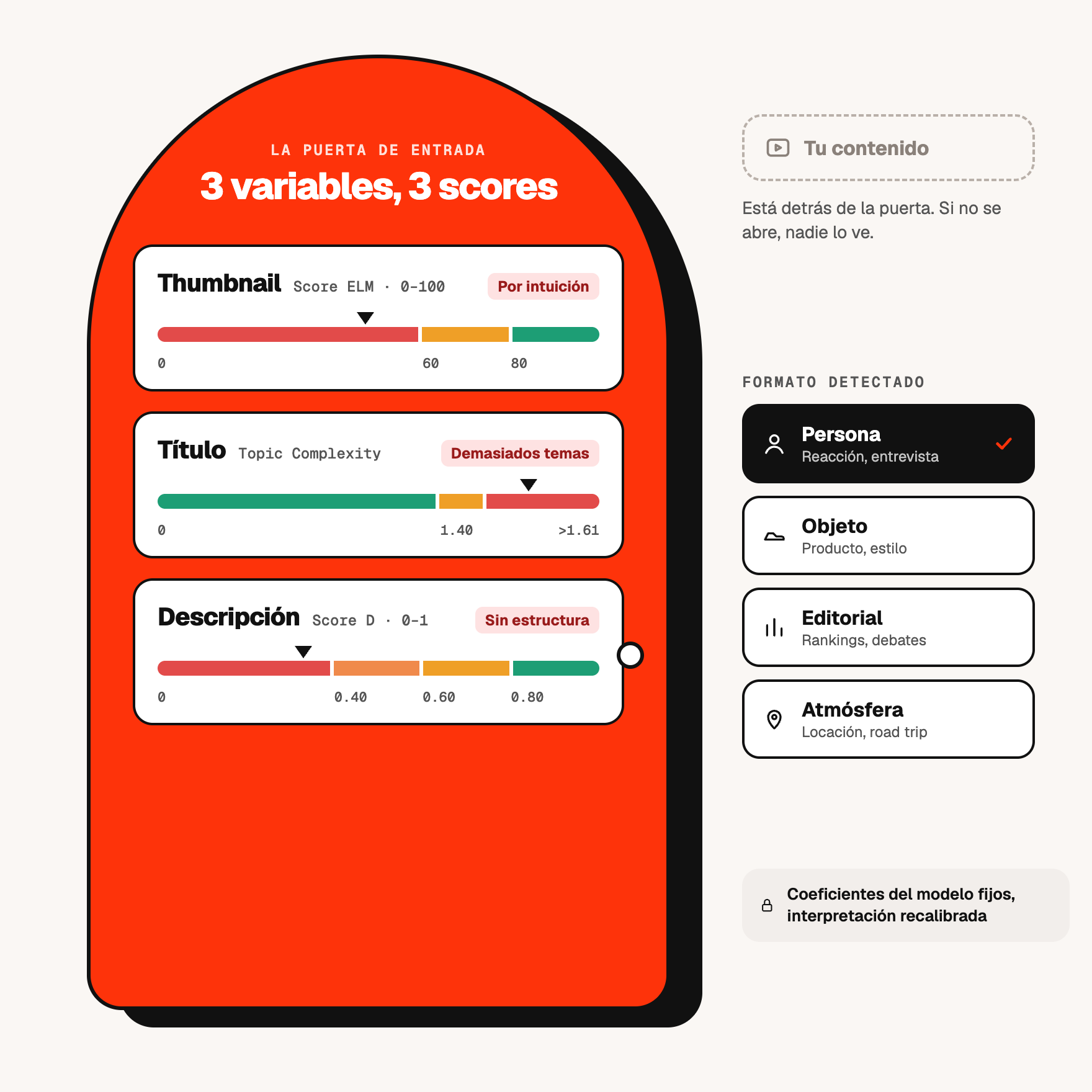
Most channels between 20K and 300K subscribers publish consistently but don't grow at the pace they should. The bottleneck is almost always the same: thumbnails designed by intuition, titles with too many topics, and descriptions with no structure.
thumbiq turns those three variables into measurable scores. You know exactly what's failing and what to change first — with measurable criteria instead of hunches.
The system automatically detects the asset's format — reaction with a person, product/style (sneakers, gadgets), editorial content (rankings, debates) or atmosphere/location (travel, experiences) — and recalibrates how each variable is read for that format, without altering the model's coefficients.

You send us the asset by email. Within 48 hours you receive the full PDF report with scores, diagnosis and prioritized recommendations ready to apply. No complicated forms, no long onboarding.


For one specific video
For channels that want to try the service before committing. Also useful for high-stakes videos, launches and pilot episodes.
- Full PDF report (up to 16 pages).
- Global ELM Score + variables.
- Clickability Index (6 dims).
- Title and Description analysis.
- Creative Distance Index (CDI), when the asset calls for it.
- 3 prioritized recommendations.
- Delivered within 48 hours.

You only need the thumbnail image (JPG or PNG) and the video title. The description is optional but recommended to get the full D Score. Everything is sent by email to contacto@thumbiq.io — no forms or external platforms.
Yes. The ELM model and the Clickability Index are visual and structural variables that apply to any niche: sports, finance, technology, entertainment, education. The system doesn't depend on the video's topic, but on how the thumbnail is composed.
Most services give you visual feedback based on opinion or personal experience. thumbiq applies the ELM model by Koh & Cui (2022) — a published academic framework with regression coefficients — and complements it with proprietary indices for clickability, title and description. Every recommendation comes with a measurable reason, not a hunch.
The system detects the Content Mode automatically — object as protagonist, editorial content, or atmosphere/location — and recalibrates how each dimension is read (for example, "recognizable figure" becomes "recognizable object" or "recognizable place" depending on the format). The model's penalty for having no person is structural to the format, not a design mistake, and it is compared against your channel's record for that same type of content.
It's an editorial, qualitative metric that evaluates the creative device behind the thumbnail — the metaphor, wink or reference chosen — not its technical attributes. It measures two axes: how far the connection is from the obvious (Conceptual distance) and how quickly it is understood without explanation (Clarity of the connection). It is reported only when the asset uses an identifiable creative device, and it does not change the ELM Score or the Clickability Index.